Ranger Medics Saves Lives in Combat!
July 21, 2020
75th Ranger Regiment Public Affairs
“Never shall I leave a fallen comrade…” third
stanza of the Ranger Creed.
On a hot, dark night in Wardak province, Afghanistan last summer, a special
operations Ranger raid force conducted a helicopter insertion, beginning what would become
a historical night. The routine Ranger task of capturing or killing high value enemy
targets would tonight include cutting edge lifesaving procedures never done in combat,
with the stakes of life or death hanging in the balance.
While clearing through the objective, the assault force began receiving accurate
Ak-47, machine gun (PKM), and other small arms fire from multiple enemy fighters near the
target compound.
The Ranger assault force returned fire on the enemy positions, utilizing their M4
carbines and squad automatic weapons along with shoulder fired rockets and grenade
projectiles. They attempted to do what few men and women would ever choose to do. Close
with and destroy the enemy.
As the assault force maneuvered on a shooter who barricaded himself into a fighting
position, they were rocked by a large explosion near the breach of the target compound.
When the debris landed and the dust settled, three Rangers were wounded in action and the
fight for their lives began.
Leading that fight were two Ranger Combat Medics, Staff Sgt. Charles Bowen and Sgt.
Ty Able, from Bravo Company, 1st Battalion, 75th Ranger Regiment. They saved six lives
that night.
As the explosions and bullets riddled the area around Bowen and Able, they made
careful calculations and risked their own lives for their brothers. Maneuvering within
meters of the barricaded enemy shooter, they surged to evacuate the wounded from the midst
of the battle raging around them.
Bowen and Able quickly assessed the two wounded casualties and directed
Advanced-Ranger First Responders certified teammates, the 75th Ranger Regiment’s
equivalent to Emergency Medical Technicians, on how to continue medical treatment.
“The first casualty yelled out ‘I’m hit, I’m hit!” I looked at his leg and did not
see any blood so I told him to go outside of the building and have someone evaluate his
wounds,” Bowen said. “At the same time, the second casualty yelled out ‘Doc, I’m real
messed up!’”
A Ranger, an Afghan partner force soldier, and Bowen made their way through the
dusty corridor to the courtyard where they saw the second casualty laying on the ground.
He was conscious but contorted in an alarming manner.
Without hesitation, Bowen identified the critically wounded casualty and rapidly
pulled him behind the only nearby cover from the enemy gunfire, a small lump of earth no
more than one meter high.
Through the chaos of the enemy fire, Bowen determined the second casualty was
critically wounded and began crucial lifesaving interventions.
“We began dragging the second casualty toward a safer location through the corridor
and out of the breach,” Bowen said. “After getting the casualty out of the breach, I began
to treat him with the help of others around me.”
Bowen quickly placed a tourniquet on the man’s right arm and leg and a junctional
tourniquet around his pelvis.
“I asked the second casualty if he could hear me and he responded with ‘Yeah, it
really hurts, Doc,’” Bowen said.
Bowen cut off the man’s body armor to get a visual of his wounds, exposing a gaping
hole on the right side of his chest.
“I went to my (medical) aid belt and pulled out a needle chest decompression, an
intravenous kit and one gram of pre-drawn Tranexamic Acid (TXA, a medication for trauma
patients that reduces death due to bleeding),” Bowen said.
After checking his back for additional wounds, Bowen began an IV and administered
the TXA and found that the man’s radial pulse was rapid and weak. After this find, Bowen
felt the casualty’s chest and found that the left side was not inflating.
While Bowen performed lifesaving advanced resuscitation efforts on the man’s
bleeding limbs, he directed Able and a Ranger assaulter to manage the critical chest
wounds.
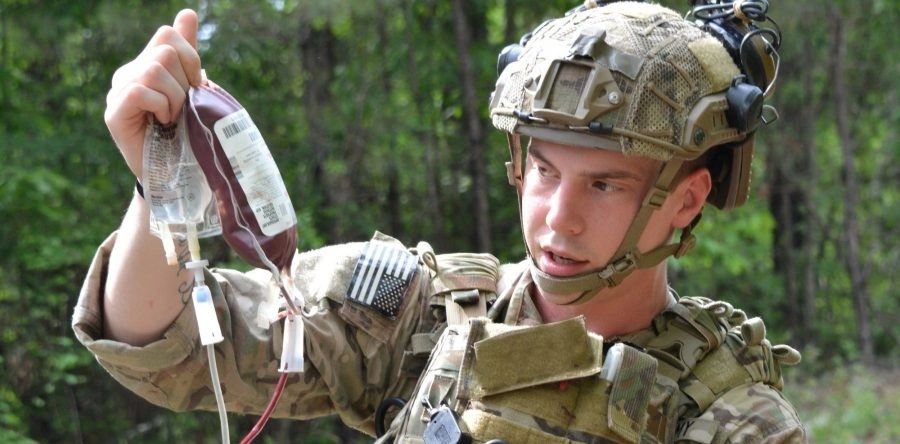
At this point, the casualty had received two units of cold stored whole
blood, the stock every Ranger medic carries into combat with them.
Bowen and his team then hastily moved the casualty to the casualty collection
point.
When they arrived, Bowen reassessed the man’s wounds while Able checked on the
other two casualties from the initial blast.
As this was occurring, the casualty collection point was taking effective enemy
machine gun fire and even received a fragmentation grenade from as close as 15 meters
away.
During the melee, the strike force platoon sergeant told Bowen there was yet
another casualty.
Within a minute of this report, the new casualty came from the wood-line, stumbling
in Bowen’s direction with blood gushing from a wound on the left side of his neck.
“As
he fell into me with his multi-purpose canine still attached to his belt, I told him to
put pressure on the wound. He replied, ‘I’m trying!’” Bowen said.
With blood pouring from the neck of the new casualty, Bowen placed his middle finger
into the hole in his neck to stop the bleeding.
Still applying pressure to the neck wound, Bowen established a second casualty
collection point to manage the two critically wounded casualties (the second and third
casualties). While under direct enemy fire, Bowen and Able assessed the neck wound while
lying on the ground to avoid further harm to themselves and other casualties.
Bowen identified the massive hemorrhage in the neck of the new casualty, which was
causing an obstructed airway. Laying in the dirt, under enemy fire directly hitting their
position of cover and concealment, Bowen and Able performed an advanced surgical technique
known as a cricothyroidotomy to allow the wounded Ranger to breathe.
A
cricothyroidotomy is an incision made through the skin and cricothyroid membrane to
establish a patent airway during certain life-threatening situations.
“While we were taking both enemy machine gun and accurate mortar fire, I retrieved
additional medical equipment to control the bleeding,” Bowen added. “Once I had the
bleeding under control, I made a pressure dressing over the entry wound of the left side
of the neck.”
The Ranger with the neck wound was temporarily under control. However, the other
previous casualty was bleeding out rapidly due to the multiple limb and chest wounds. With
all the available whole blood units already administered to the casualties, Bowen and Able
determined the critically wounded man would die from blood loss if they didn’t take
action. They would need to exercise the Ranger O-Low Titre protocol.
“ROLO is a novel protocol created in the 75th Ranger Regiment that is transforming
how we treat battlefield casualties,” Lt. Col. Ryan Knight, M.D., 75th Ranger Regiment
Command Surgeon said. “We now always have blood on the battlefield and do not rely on
other IV fluids.”
The ROLO Program allows one Soldier to transfer his or her blood to a wounded
Soldier in just a few minutes on the battlefield. The program relies on relatively simple
medical procedures and administrative tracking of a unit’s universal donor (group O blood)
volunteers, providing huge quantities of whole blood when a situation requires it.
When called upon, a blood donor volunteer moves to the casualty and pulls out their
issued blood donor pack. Either the unit’s combat medic or a trained non-medic Ranger
draws the blood from the volunteer. The volunteer then returns to combat and the blood is
immediately administered to the casualty. The whole process takes about 10 minutes.
Bowen,
Able, and an Advanced-Ranger First Responder did this protocol three times, under direct
enemy fire to save the lives of two critically wounded casualties.
“To provide this level of care, Bowen and Able, had to ignore their own survival
instincts and concentrate on their patients. They displayed the highest levels of courage
as they repeatedly placed their patients’ survival above their own safety,” Knight said.
“They will say they were just doing what they are trained to do, and in some ways they are
right.”
“However, although we simulate incoming fire and force medics to treat in the
prone position during training there is no way to accurately reflect the reality of
combat,” Knight added.
While the medics were conducting lifesaving medical treatment, the assault force was
reengaged by the enemy from three buildings in the adjacent village approximately 80
meters away from the casualty collection point.
Due to the volume of direct fire, both Bowen and Able covered their patients with
their bodies in order to prevent further injury or possibly even death.
“As all of the treatments and movements while under enemy fire were occurring,
danger close fire missions with hellfire missiles, 30mm rounds, and 105mm rounds were
being executed as close as 30 meters from our position,” Bowen said. “As this was
happening, Sgt. Able and I did our best to shield our casualties from harm and covered
their ears during impact of the large munitions.”
During nearly 30 minutes of sustained direct fire enemy contact, Bowen and Able
facilitated the ROLO protocol once again, drawing two more units of fresh whole blood to
aid in the treatment of both critically wounded casualties.
Even as two MH-47s came in for exfiltration, the assault force again came under
heavy enemy fire. Able began to engage the enemy with small arms, providing the necessary
cover for his teammates to load the casualties onto the helicopter. Once the casualties
were loaded, Able then maneuvered to the aircraft for exfiltration. He continued firing at
the enemy until the helicopter had taken off.
“Sgt. Able’s treatment of casualties, superb medical treatment recommendations, and
overall calm demeanor while within accurate small arms and fragmentation grenade range,
undoubtedly saved the lives of his fellow Rangers,” Cpt. Edmund J. Carazo, Bravo Company
Commander, 1st Battalion, 75th Ranger Regiment said. “His disregard for his own safety
while performing life-saving care is exemplary and serves as an example for all Rangers to
follow.”
Bowen and Able treated a fatal hemorrhage, triaged two additional casualties, and
successfully packaged the critically wounded in 13 minutes, before movement to the
casualty collection point.
“Staff Sgt. Bowen’s actions during this operation are some of the most impressive
feats I’ve ever witnessed,” Carazo said. “Not only did his actions save the lives of his
fellow Rangers, but he performed a staggering display of technically superior field
medicine while under fire for more than 90 minutes. His blatant disregard for his own
safety was evident throughout.”
From the first explosion that wounded three rangers
until the casualties were evacuated to the next level of medical care, was approximately
two hours.
Two hours under heavy enemy fire, danger close, with two of the casualties
critically wounded, Bowen and Able’s leadership, courage under direct enemy fire and the
ability to administer life-saving aid, was without a doubt the reason three Rangers came
home from this deployment.
“Every link in the system worked that night to save these lives. Rangers train
casualty care every day, leaders train to handle casualties, and our medics take pride in
being the world experts in tactical combat casualty care,” Knight said. “While this is an
amazing display of personal courage, medical expertise, and the most incredible saves I’ve
ever heard of, it’s also Rangers living the Ranger Creed and is what we expect every day
from the 75th Ranger Regiment.”
The 75th Ranger Regiment’s leaders are hopeful that their recent success
administering whole blood and executing the ROLO program in combat will inspire units
across the Department of Defense to adopt the relatively simple programs, greatly
improving medical options for units on the battlefield.
The ROLO program can be implemented at any unit. It is the fusion of administrative focus and adequate medical training. For further, detailed information contact the 75th Ranger Regiment Medical Section at [email protected].